
An HVAC contractor may become familiar with a cafe’s building, access restrictions, operating hours, and service history. That continuity can be useful, but it does not establish perfect temperature control or determine how food-service equipment performs. When the contracting business changes ownership, a cafe manager should verify what the new provider actually received and what the governing records say.
Do not assume that contacts, agreements, pricing, warranties, open work, or service procedures will automatically change or remain the same. Each contract, warranty, lease, and transaction is different. The practical task is to gather the cafe’s own records, ask specific questions, and document the answers supplied by the provider, landlord, or other authorized party.
This review is not a technical inspection or a substitute for legal, insurance, or contract advice. It is an operational handoff checklist. Completing it helps managers know whom to contact, what documentation is available, and which items still need a qualified decision.
Verifying Contacts and Reviewing Current Agreements
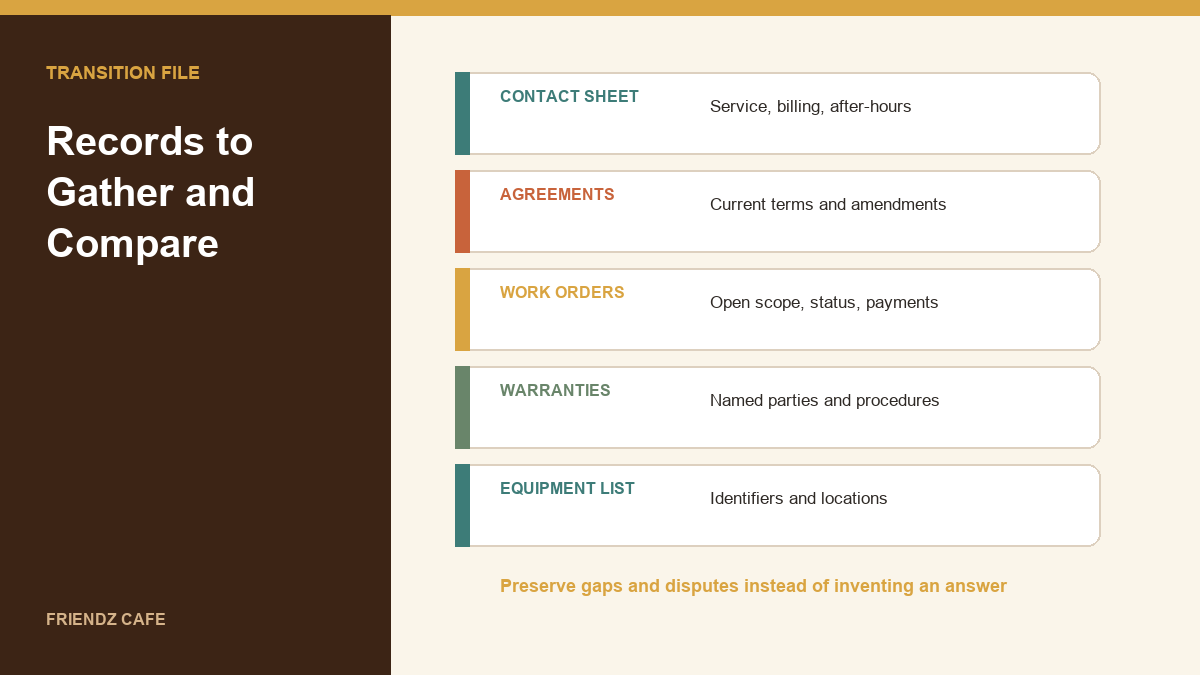
Start by requesting a current contact sheet from the provider. Identify the account contact, ordinary dispatch channel, after-hours procedure, billing contact, and the method the provider uses for work-order updates. Store that sheet in the cafe’s controlled operations file so the manager on duty can find it. This is separate from the customer etiquette guidance in what makes a neighborhood cafe work, but both depend on staff having clear procedures.
Next, locate the actual maintenance agreement and any amendments. Ask the provider to state in writing which entity now performs the work, which terms it believes remain in effect, and whether it is proposing any changes. An informal courtesy from the previous operator may not appear in the agreement. If a new document is offered, compare the service scope, frequency, response language, exclusions, price, renewal, termination, and notice provisions before an authorized person signs it.
Confirm invoicing and administrative procedures as well. Verify the legal payee, remittance instructions through a trusted channel, purchase-order requirements, tax documentation, and the date any billing change begins. A cafe should follow its own payment-fraud and vendor-change controls rather than relying on an unexpected message.
Securing Your Maintenance History and Equipment Records
A maintenance history can help establish what work was requested, performed, deferred, or recommended. What a landlord, insurer, manufacturer, or contract requires depends on the applicable documents. The cafe should keep its own copies instead of assuming the incoming provider received a complete database.
Ask for the service history the provider is authorized to share, then compare it with the cafe’s invoices, work orders, equipment list, and prior correspondence. Confirm equipment identifiers, general locations, and open recommendations. Do not ask cafe staff to enter roofs, mechanical rooms, electrical spaces, or other controlled areas to collect information.
If you maintain your own internal logs, as recommended by the EPA Building Air Quality Guide, this is the perfect time to cross-reference your records with theirs. Ensuring both parties have a shared understanding of the equipment’s condition and history establishes a strong foundation for the new working relationship.
Addressing Open Work, Warranties, and Access Permissions
If work is open during the transition, record the original work-order number, quoted scope, deposits or prior payments, parts status, responsible entity, and next promised update. Ask whether the incoming company accepted the order and how any change will be documented. Reconcile later invoices against these records; do not assume that either company has resolved the allocation.
Warranties require the same document-specific approach. Separate a manufacturer’s parts warranty from a contractor’s labor promise, maintenance obligation, or other coverage. Read the warranty and related agreement, note the named parties and claim procedure, and request written clarification from the relevant provider or manufacturer. Direct legal, insurance, and lease questions to qualified advisers.
The seller side of an HVAC-company transaction illustrates why organized records matter. A guide for HVAC business owners preparing for a sale identifies customer records, recurring agreements, licensing continuity, and operational documentation as issues an owner may need to organize. A cafe customer should still verify its own agreement and service history because the completeness, transferability, and effect of those records depend on the actual transaction and documents.
Re-establishing Site Familiarity and Access Protocols
A new provider may assign technicians who do not know the cafe’s delivery entrance, permitted work windows, alarm procedure, landlord approval process, or customer-area restrictions. Create a brief site-orientation record that covers only information the cafe is authorized to provide.
During the first visit, have an authorized manager confirm check-in, escort, key or badge, after-hours, waste-removal, and customer-area procedures. Identify controlled roof, mechanical, electrical, or ceiling access without directing unqualified staff to open or demonstrate it. Schedule disruptive work outside peak periods when feasible, using the same consideration for shared space described in working from a cafe etiquette.
Tell the provider about legitimate operating constraints, but let qualified parties determine the technical response. The ENERGY STAR small-business toolkit recommends tracking energy use and involving employees in efficiency efforts. That supports recordkeeping and communication; it does not replace equipment-specific instructions from qualified professionals.
Building a Transition Tracker with Owners and Dates
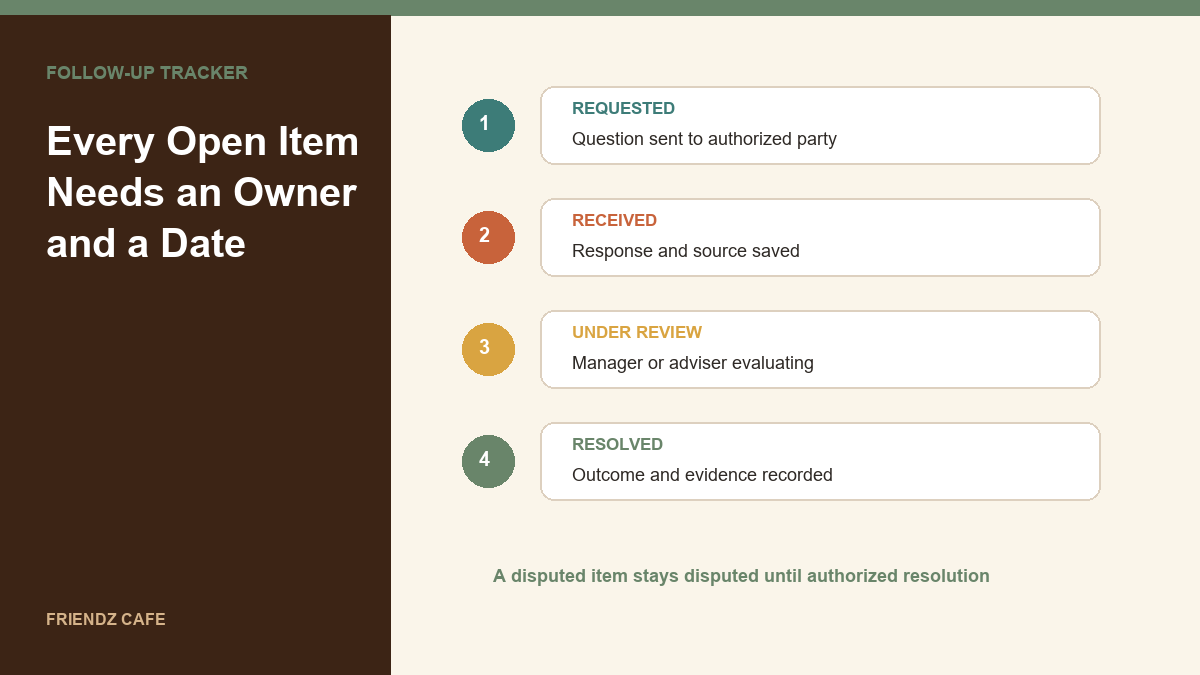
A one-page transition tracker keeps the review from becoming a collection of emails with no clear outcome. Give each item a neutral description, the source document or work-order number, the party expected to answer, the manager responsible for following up, the date requested, and the next review date. Use status labels such as requested, received, under review, resolved, or referred for qualified advice. A disputed item should remain disputed until the authorized parties resolve it.
Keep evidence with the tracker. Attach the provider’s current contact sheet, the cafe’s agreement, amendments, work orders, invoices, warranty documents, and written responses. Record what was received without rewriting technical or contractual language into a stronger claim. If the provider cannot locate an older record, note that gap and preserve the cafe’s own copy rather than treating the absence as proof of what happened.
Limit access to people who need the file for operations, accounting, property management, or professional review. Service records may contain vendor, employee, facility, or account information that should not sit in a public binder. The tracker is complete when every item has an owner and next action, not when the cafe has forced every question into a yes-or-no answer.
Confirming Everything in Writing
Keep written records of questions, answers, open items, and the person responsible for each follow-up. A conversation summary can be useful, but it does not amend a contract unless the applicable agreement and authorized parties make it effective.
Review any welcome packet or replacement agreement before an authorized person signs it. Compare it with the existing record, flag differences, and obtain qualified advice when the legal effect is unclear. The goal is not to demand a predetermined outcome; it is to know which terms and responsibilities are documented.
A controlled transition file should end with a current contact sheet, available service history, equipment identifiers, open-work status, contract and warranty questions, site-access protocol, and assigned follow-up dates. That gives cafe managers a practical reference while the appropriate professionals resolve technical and contractual matters.
FAQ
What should a cafe verify first after an HVAC contractor is sold?
Request a current contact sheet, identify the entity handling service and billing, and list every open work order. Then compare the provider’s records with the cafe’s own files.
Does a maintenance agreement automatically transfer?
It depends on the agreement and transaction. Read the specific documents, request written clarification from the authorized parties, and obtain qualified advice if the legal effect is unclear.
How should a cafe orient a new HVAC technician?
An authorized manager should confirm check-in, escort, work-window, customer-area, and controlled-access procedures. Staff should not open or demonstrate mechanical, roof, or electrical areas unless authorized and qualified.
What happens to a labor warranty after the contractor changes ownership?
Coverage depends on the written warranty, named parties, and transaction. Separate manufacturer and contractor obligations, then follow the documented claim and clarification process.

0 Comments